
Recovering the missionary heartbeat that shaped the British Isles and still sends the Church today.
By Bishop Jonathan
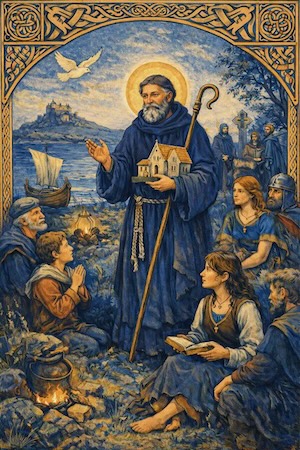
Image created by AI.
Why the Celtic Mission Still Lives
When people hear the word evangelical, they often imagine something modern, such as revival meetings, church plants, energetic preaching, and a strong call to personal faith in Jesus.
But what if evangelical instincts are far older than we think? What if the evangelical impulse from British Christianity predates the practices of the Roman church?
Long before the Reformation, before denominational debates, before contemporary mission agencies, the winds of renewal were already blowing across the British Isles.1 Even before St. Patrick’s famous campaign to evangelize Ireland, Christianity had already begun to take root in the British Isles, leaving a distinct accent on English Christianity.2
This form of Christianity became known as Celtic.
Celtic monks crossed the seas in fragile boats. They entered pagan villages. They preached Christ, baptized converts, discipled families, and established communities of worship and prayer.
This was the world of Aidan of Lindisfarne, sent from Iona Abbey to evangelize Northumbria. It was a movement marked by courage, mobility, Scripture, and deep pastoral care.
In other words, it looked remarkably catholic and evangelical. At the heart of both is an emphasis on an embodied experience and a lived allegiance to Christ.
A Missionary People
The Celtic tradition did not conceive of the Church as a settled institution awaiting the arrival of guests. Instead, the tradition embodied the idea of being missional or apostolic, with emphasis on ‘being sent.’3
At the center of these activities were abbeys and monasteries that served as places of worship, study, training, and mission. From these mission centers, monks were sent out to the surrounding areas.
Monks walked from village to village, teaching the faith. They trained converts carefully. They built small communities that prayed the Psalms, celebrated the sacraments, and lived under spiritual oversight. Celtic monks became renowned for meticulously copying and studying biblical texts.
They believed the Gospel should spread through relationships and expected to see transformed lives.
They organized believers into an accountable fellowship.
Sound familiar?
Continuity, Not Novelty
Centuries later, when renewal movements surged within the Church of England, many of these same echoes reappeared. Open-air preaching. Structured discipleship. Engagement with Scripture. A passion for conversion. A drive to reach those outside parish walls.
Leaders like John Wesley and George Whitefield, both English Churchmen, did not set out to abandon the Church. Instead, they sought to awaken it from its slumber.
What emerged, then, was not a brand-new spirituality but a recovery of an older missionary DNA embedded in the history of the English people, altogether Catholic but not Roman.
Yes, there are differences. Some modern versions of Celtic spirituality emphasize reverence for nature in ways that diverge from historic Christian teaching. That tells us more about present spiritual longings than about the actual theology of Celtic Christianity.
But the same could be said of forms of evangelical spirituality that can tilt toward a spirituality so detached from sacramental and embodied life that it begins to exhibit gnostic tendencies, which the wider Church has long resisted.
Setting aside those errors, what remains is a tradition worth recovering as we move further into the post-Christian West.
Monastic Mission Centers
Celtic Christianity grew through vowed communities with shared prayer rhythms and a call to monastic life. Evangelical renewal mobilized lay men and women who remained in ordinary life.
One sent monks from an abbey. The other sent believers from societies.
Reach seeks to form the same kind of people: holy men and women, deeply formed and sent outward, carrying Christ into the world.
What early Celtic Christians and Evangelical Anglicans share is a common set of values.
We believe missionary leadership must be cultivated intentionally. We believe people require grounding in Scripture, stability in worship, and real spiritual oversight. We believe communities should multiply through relationships. We believe the Spirit still sends ordinary Christians into homes, neighborhoods, cities, and nations.
None of that is new.
It is the old path, walked again.
Reach Global Missions walks the same path once taken by wandering bishops and courageous evangelists, grounding people deeply, then releasing them to bring Christ to towns, neighborhoods, and nations.
Works Cited
1. Ron Geaves, “Celtic Church,” in Continuum Glossary of Religious Terms (London; New York: Continuum, 2002), 74.
2. Ibid., 74.
3. George Thomas Kurian, in Nelson’s New Christian Dictionary: The Authoritative Resource on the Christian World (Nashville, TN: Thomas Nelson Publishers, 2001), see “Celtic Church.”